The Sun and Moon Both Matter
Are you aware that the sun affects Earth’s tides? Ocean tides result from gravitational forces from the moon and sun. Gravitational pull can be calculated based on the mass divided by the cube of the distance. Given that the sun has 27 million times more mass but is 390 times farther away, it is 27,000,000 / (3⁹⁰³) = 0.455, roughly half of the moon. In other words, the moon influences about two-thirds of the tide [1 / (1 + 0.455)], and the sun only about a third.
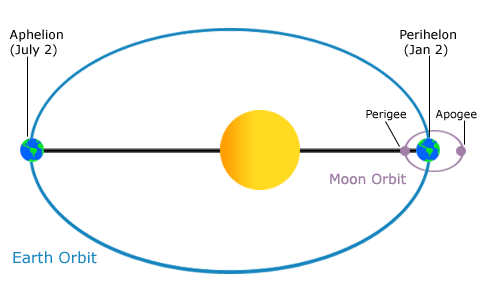
Why Planets Have Little Effect
Our solar system’s other planets have little impact on tides. Because Venus is closest to earth, it has the most influence. But even at its maximum power, its effect is 10,000 times smaller than that of the sun and moon combined. Jupiter exerts a force less than a tenth of that of Venus. Therefore, the planets’ effects on earth’s tides are undetectable.
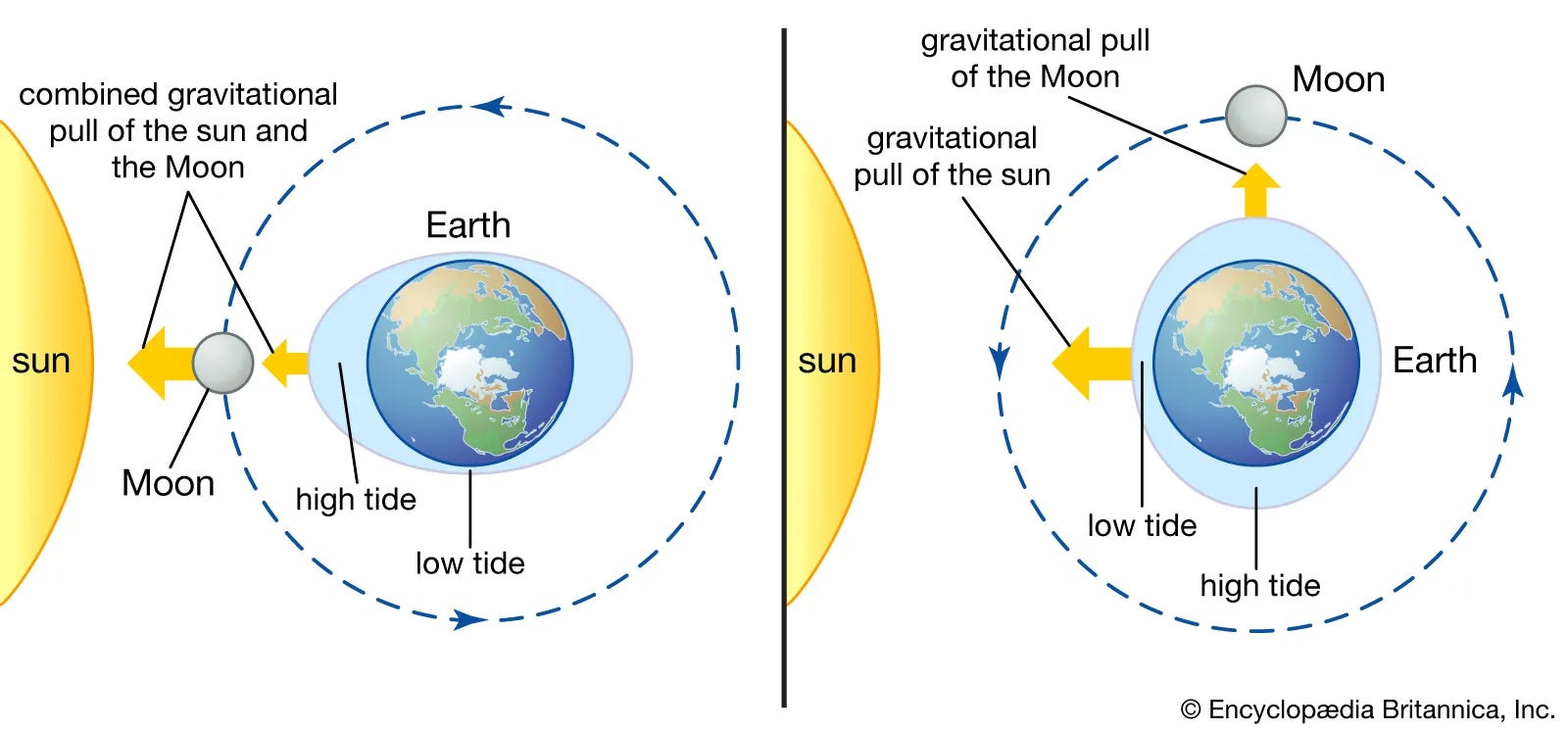
Credit: Encyclopedia Britannica
Tidal Force and Ocean Bulges
The moon’s gravitational pull creates something called the tidal force. Due to the tidal force, earth’s water bulges out on the side closest to the moon and the side farthest from the moon. These bulges are known as high tides.
More Tide Facts:
- Tide cycles last 24 hours and 50 minutes.
- The highest tides occur during full or new moons.
- High tides sometimes happen when the moon is directly overhead.
- During Neap Tides, which occur twice a month, the difference between high and low tides is minor.
- Some places only experience one high tide and one low tide per cycle.

