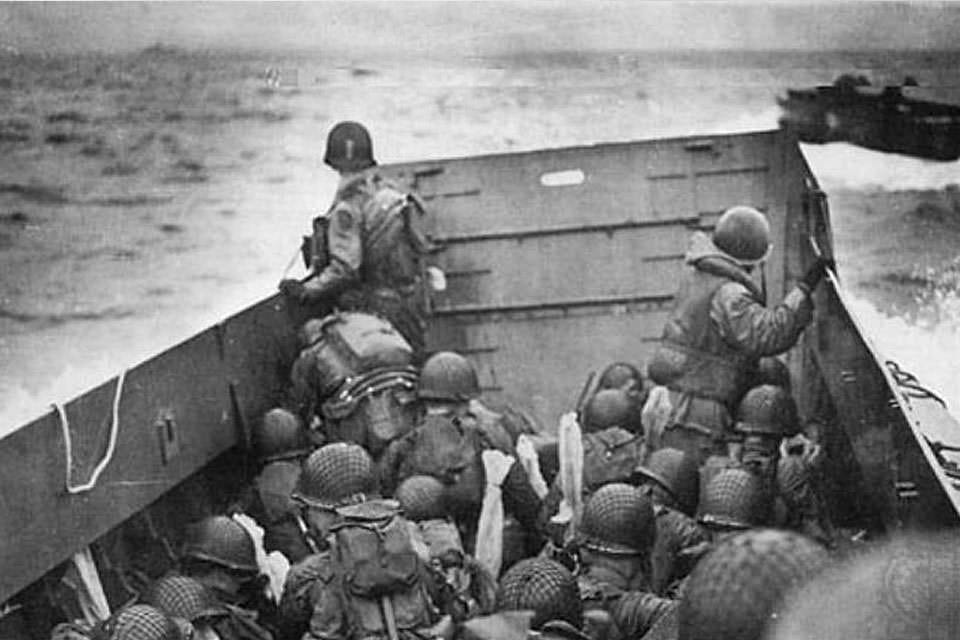
Credit: U.S. Army
D-Day Needed the Right Tide
It sounds like the title of a movie, but Operation Neptune was the code name for D-Day, the largest seaborne invasion in history. Perhaps you’ve seen footage of the troops coming ashore in Normandy; well, if not for the tide prediction machine, that may never have happened.
During World War II, thousands of troops landed in Normandy as part of an amphibious landing on June 6, 1944. In addition to liberating Germany-occupied France, D-Day laid the foundation for Allied success in western Europe. To plan this assault, many factors had to align; good weather, a full moon to light the way the night before, and most importantly, a low tide prior to dawn.
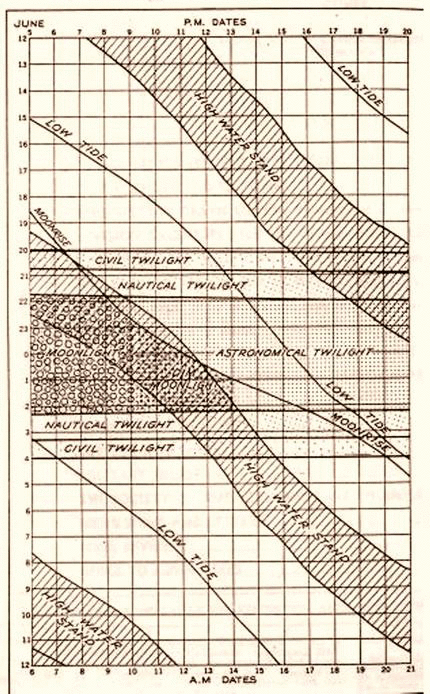
Tidal Diagram for Omaha Beach, June 1944. Credit: Physics Today
Why Low Tide Mattered
The Germans put cement obstacles underwater to prevent the impending invasion. German Field Marshal, Erwin Rommel, believed that Germany was doomed if it did not stop the Allies at the beaches so, in February 1944, he began building underwater obstacles in the intertidal zone. It was known as the Atlantic Wall. The water, during mid-tide, would cover the barriers and tear off the landing craft’s bottoms without being seen.
But allied aerial reconnaissance noticed the obstacles and understood their purpose. They would need to calculate exact harmonic constants from tide data measured at or near the landing beaches to produce accurate tide predictions for the Normandy beaches and use the measurements for the invasion plan.
Doodson and the Tide Machines
The Liverpool Tidal Institute produced all Admiralty tide and current forecasts for the war effort under Arthur Thomas Doodson. Doodson was the world’s leading authority on tide prediction at that time. He used two tide-predicting machines for the Normandy invasion, one created by Lord Kelvin in 1872 but overhauled in 1942, and the other designed by Edward Roberts in 1906.
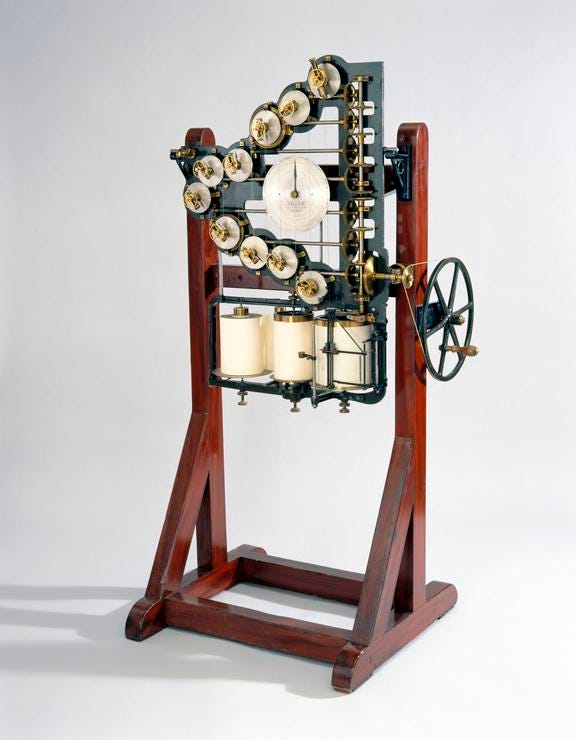
Kelvin’s Tide Prediction Machine. Credit: Science Museum Group UK
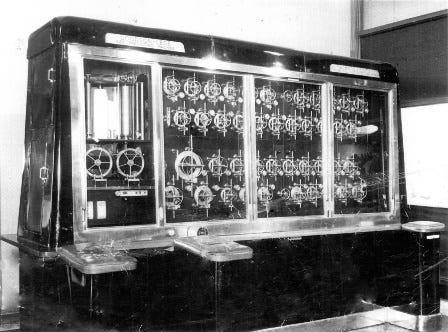
Robert’s Tide Prediction Machine. Credit: Science Museum Group UK
Normandy’s invasion faced many constraints, but the tide prediction was essential to the assault’s success.

