Why Tide Range Matters
It’s a beautiful day at the beach. You find the perfect spot to set up your umbrella and lay out your towel. Next, you cover yourself with sunscreen and take a nap. Moments later, you’re soaked, and your flip-flops float out to sea. If you had checked the WorldTides app, you would have known your setup needed to be much further back. Now, can you imagine a high tide that fluctuates between 47.5 and 53.6 feet?

Canada’s Bay of Fundy at Burntcoat Head in Nova Scotia. Credit: Shawn M. Kent.
The Bay of Fundy Record
Canada’s Bay of Fundy, which separates New Brunswick from Nova Scotia, has the highest tidal range on the planet! More seawater flows through the Bay of Fundy than all the world’s freshwater rivers combined! Each day, 160 billion tons of seawater enter and leave the Bay. Despite the Bay’s official tide height of 15 meters, 50 feet, incoming tides are not 50 feet high because the tidal change is a six-hour process. Hence, the tide takes more than an hour to rise 10′ vertically. But it’s still a powerful force, and in some places, it can change the direction of a river, reversing rapids in Saint John, N.B., or creating a tidal bore that flows against the current.
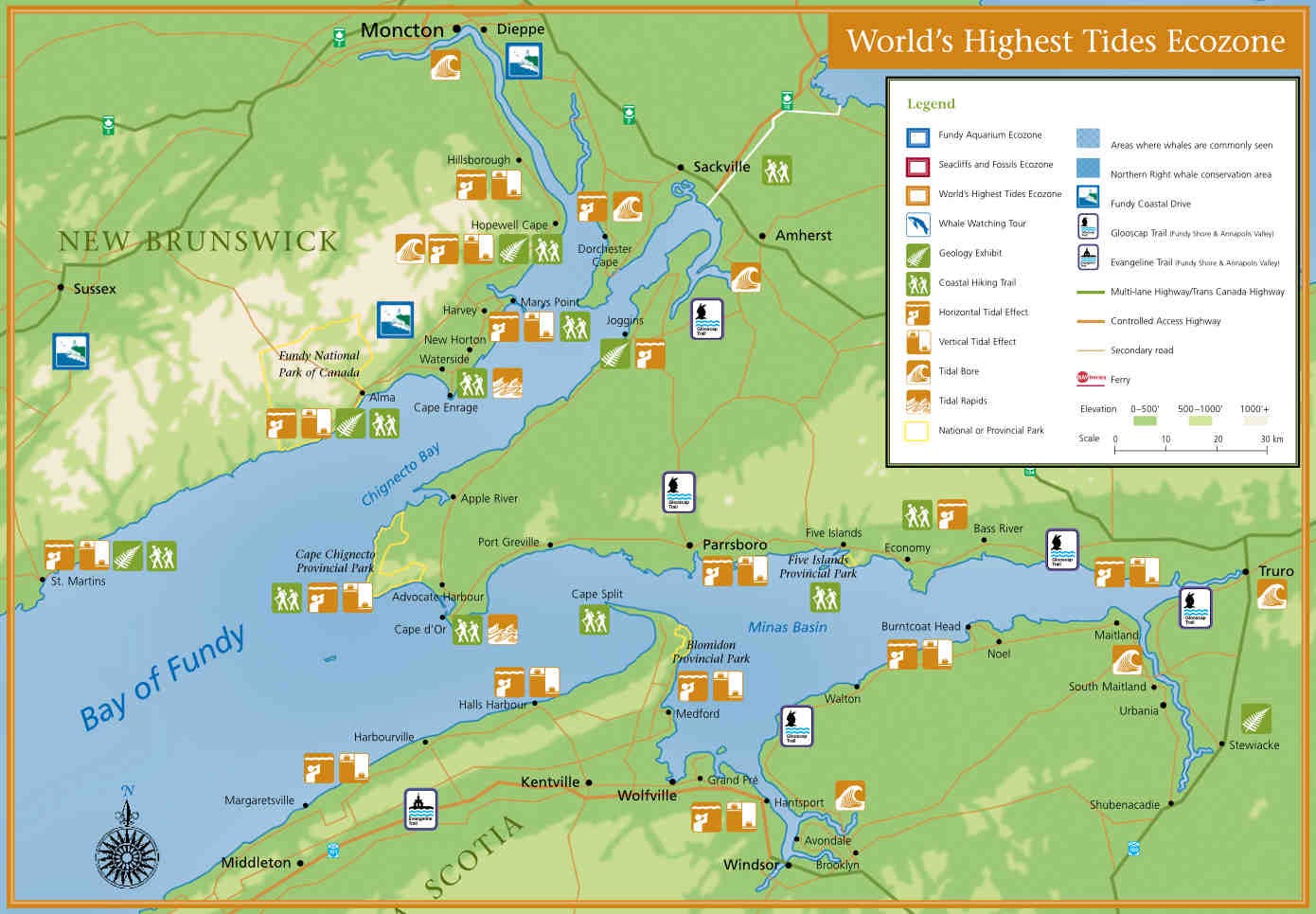
Map of Bay of Fundy. Credit: Bay of Fundy Tourism
What Controls High and Low Tides
It is worth noting that various factors affect tidal highs and lows, the gravitational pull of the sun and moon, the shape of coastlines, and storm systems on land and at sea. Because Alaska, Canada, and northern Europe have high tide ranges, there is a misconception that tide ranges increase as you move further from the equator and closer to the poles. However, this is not the case. In the northern hemisphere, the continents of North America, Europe, and Asia are closer together. Due to this constriction of the ocean, there is a more extensive range of tides. The tidal ranges do not increase in the higher latitudes of the southern hemisphere, such as in South America, South Africa, Australia, and Antarctica, because the continents are further apart.

