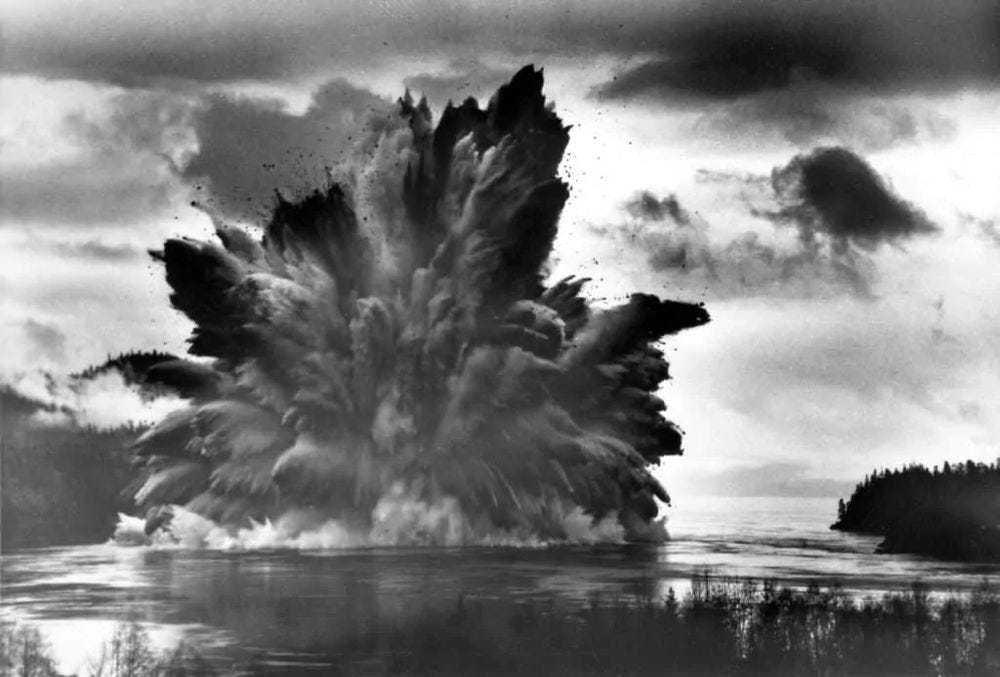
Ripple Rock Explosion, British Columbia, Canada. Credit: Campbell River Museum via Amusing Planet
A Dangerous Underwater Peak
In the treacherous Seymour Narrows, near the Campbell River in British Columbia, there was an underwater mountain with a dangerous reputation for destroying vessels. Known as Ripple Rock, it caused the sinking or damage of more than 100 ships and claimed the lives of at least 114 people before its destruction in 1958.
It took until 1942 for the Marine Commission’s recommendation to authorize the removal of it. Despite the rock’s obvious danger, some people insisted on keeping it intact. They wanted it to remain in place to build a railroad bridge between Vancouver Island and the mainland. However, the government decided that improving the waterway’s safety was a bigger priority because it provided a connection between the north and the rest of Canada and the United States.
Ripple Rock explosion 1958. Credit: Amusing Planet
Why Surface Drilling Failed
In 1943, a 46-meter-long barge was floated over the rock, held in place by steel cables attached to concrete anchors totaling over 1,000 tons. The plan was to drill holes through the rock and blast it away, but the enormous drilling barge trembled and tossed in the violent current, and the attempt failed.
A second attempt was made in 1945 to affix the barge in position by attaching it to two enormous steel cables, each weighing 11 tons. The wires were stretched 135 feet above the water and across the 3,500-foot-long Seymour Narrows. Unfortunately, water turbulence rendered the operation nearly impossible, and they terminated the contract.
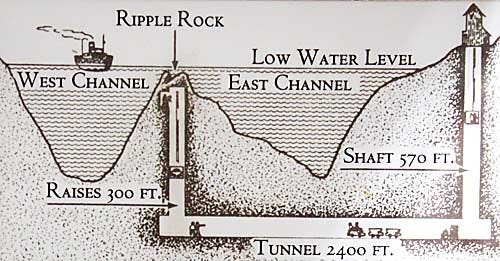
View of tunnels dug to remove Ripple Rock. Credit: http://forum.woodenboat.com/
The Tunnel Plan
Dolmage and Mason Consulting Engineers led a feasibility study on tunneling to the rock’s core in 1953. They found the underground approach feasible, and the company recommended sinking a shaft from Maud Island, going under the Seymour Narrows, and up into Ripple Rock. They sank a tunnel with multiple branches surrounding the rock and then inserted explosives into the vertical shafts.
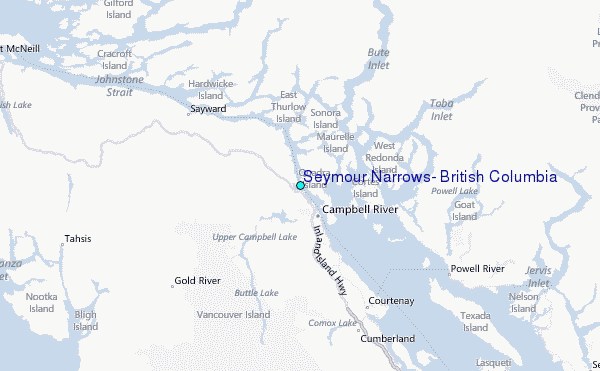
Map of the area, Seymour Narrows. Credit http://forum.woodenboat.com/
The 1958 Explosion
Ripple Rock exploded at 9:31 am on April 5, 1958. Seven hundred thousand tons of rock and water shot through the air with incredible speed and power, reaching more than 1,000 feet. The eruption lasted less than 10 seconds before a gas cloud engulfed the debris.
According to the Fisheries Department, they did not harm the marine life in the area. Orcas, porpoises, sea lions, and one fur seal near the site were seen before the explosion and after it.
Even to this day, it is still considered a marvel of engineering.
Information gathered from Museum at Campbell River & Amusing Planet.

