Tides and Earthquakes
Is there a connection between earthquakes and tides? A correlation exists between earthquakes and tides along mid-ocean ridges that underwater mountain ranges near the edges of tectonic plates. Still, no one could explain why tremors increase during low tides.
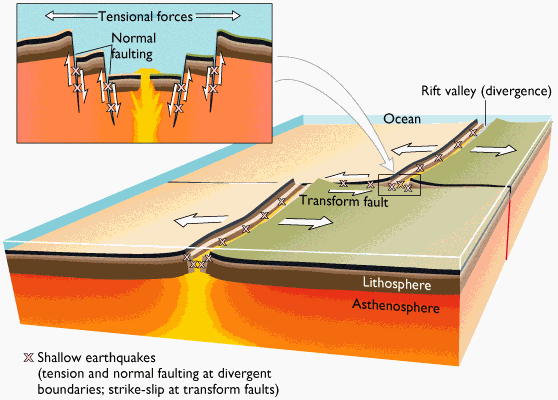
Mid-Ocean Ridge Earthquake. Credit: Seth Stein, Northwestern University Earth and Planetary Sciences
In a study published in Nature Communications, researchers found it originates from the magma below the mid-ocean ridges. Because of the mid-ocean fault, low tide correlates with the fault movement; the fault is a tilted plane that separates two earth blocks. As the upper block moves, the lower one slides down. Therefore, scientists predicted that when there is more water sitting on top of the fault during high tides, it will cause earthquakes to occur. That wasn’t the case. Instead, the fault slips downwards at low tide when forces pull upwards.
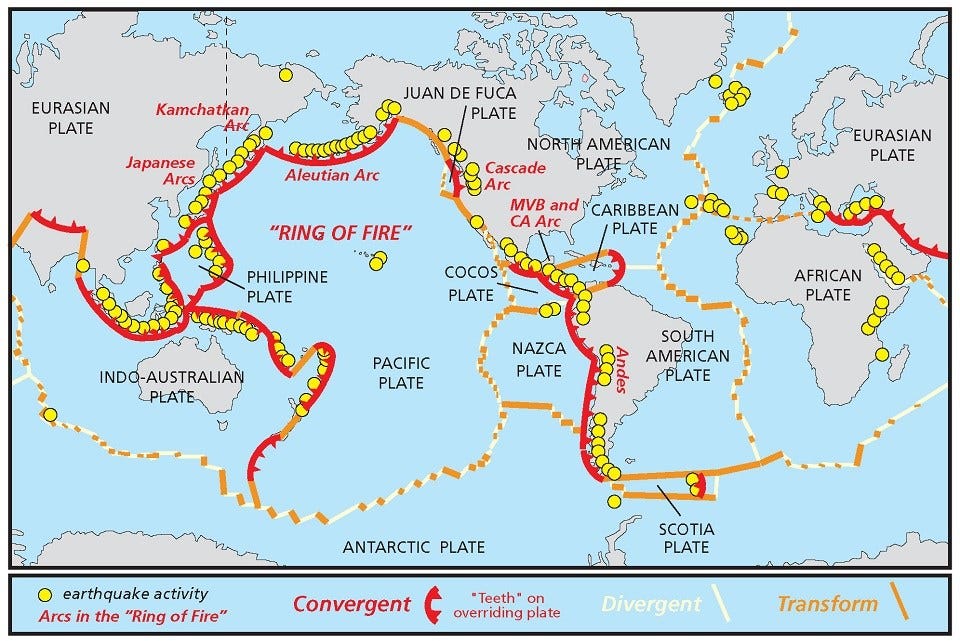
Earth’s Tectonic Plates. Credit: NPS.gov
Evidence from Axial Volcano
Scientists studied the Axial Volcano along the Juan de Fuca Ridge in the Pacific Ocean. Because the volcano erupts about every ten years, scientists have put an intricate network of ocean bottom instruments to monitor the eruptions. The researchers then explored different ways the low tides might be causing the tremors using the results. Due to the nature of these tidal earthquakes, scientists can observe details never seen before.
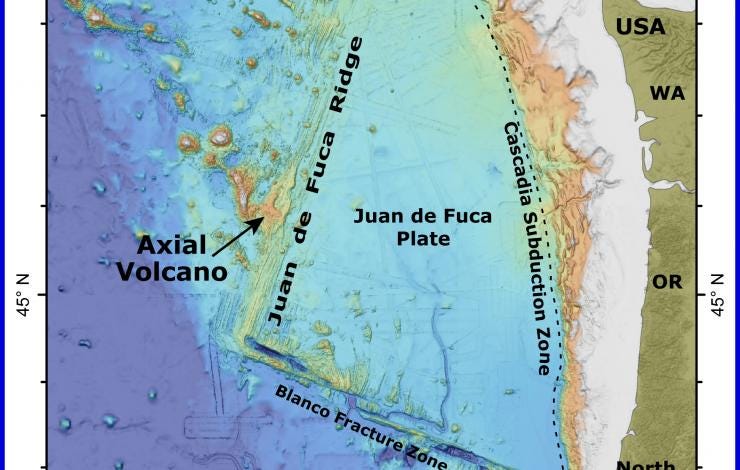
Axial Seamount off the Oregon Coast. Credit CBS San Francisco via NOAA.
How Water Pressure May Matter
No one had ever considered the magma chamber beneath the surface of a volcano until recently. When there is less water on top of the chamber during low tide, it expands. This pressure causes the lower block to slide up the fault, causing earthquakes. As the team plotted earthquake rates against stress, they realized that even minor stresses could cause an earthquake, including wastewater fracking.
This information may allow scientists to predict much larger earthquakes in the future. Before the massive earthquake that shook Sumatra in 2004 and triggered the tsunami that devastated the region, a scientist in Japan had found evidence of tidal triggering small earthquakes.

