Credit: NOAA.gov
Why Real Tides Are Uneven
Did you know that the earth would experience two equally proportionate high and low tides every lunar day if it were a perfect sphere devoid of large continents? But of course, that’s not the case.
The continents on the planet block the passage of the tidal bulges westward as the earth rotates. Due to their inability to freely move around the globe, these tides create complex patterns within each ocean basin that often differ from other regions of the same ocean basin or adjacent ocean basins. These patterns have names.
Types of Tide Cycles
Diurnal Tide
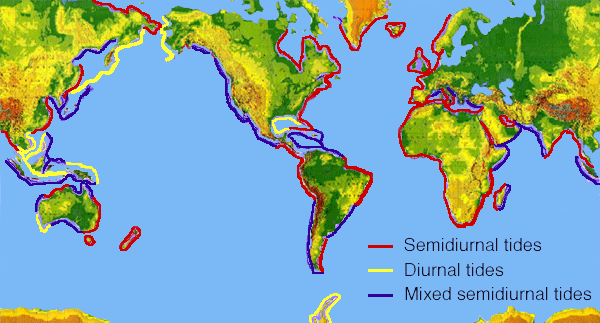
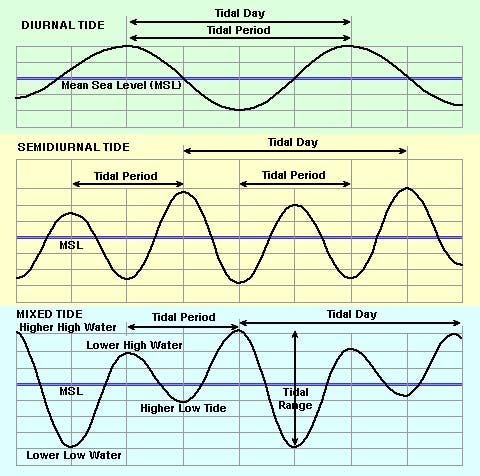
Diurnal tides have one episode of high water and one episode of low water each day. Most of these tides occur when the moon is farthest from the equator. In the United States, you can find diurnal tides on the coast of the Gulf of Mexico.
Semi-diurnal
Two equal episodes of high and low water occur each day during a semi-diurnal tide cycle. The second high tide rises to the same level as the first high tide, and the second low tide falls to the same level as the first low tide. The most common tidal pattern is semi-diurnal tides, which occur when the moon is directly over the equator. In the United States, you’ll see semi-diurnal tides along the Atlantic coast.
Credit: https://gotbooks.miracosta.edu/oceans/
Mixed
As with semi-diurnal tides, mixed tides can have two episodes of high water and two episodes of low water per day. In contrast to a semi-diurnal tide, mixed tides are not equal; their levels don’t rise and fall equally. Mixed tides can occur with both sets of unequal high or low waters or can exist with only one set of unequal high or low waters. Mixed tides happen when the moon is far north or south of the equator. You can see mixed tides along the Pacific coast of the United States.
Meteorological
As you can see, the first three tides listed are astronomical tides, meaning they are affected by the gravitational pull of the sun and moon. Meteorological tides are affected by atmospheric conditions; these include wind, barometric pressures, rainfall, ice melting, and land drying. Storm surges, resulting from inverted barometric pressure combined with wind, are also meteorological tides.

