Credit: Encyclopediabritannica.com
A Shortcut Between Oceans
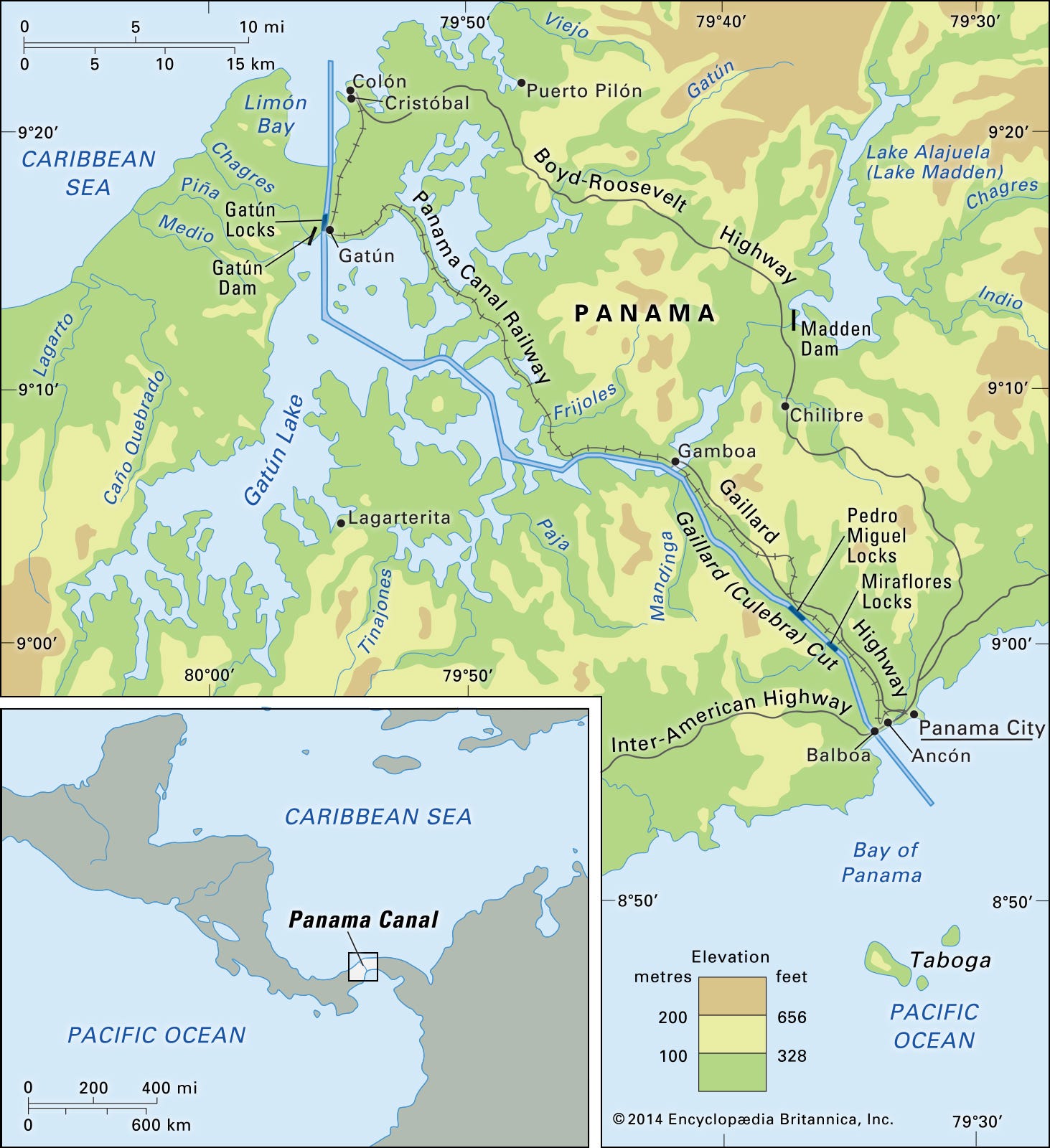
The United States built the Panama Canal in the early 20th century, joining the Atlantic to the Pacific by way of a 51-mile strip across the Isthmus of Panama. Ships would no longer have to circumnavigate South America to carry cargo from east to west.
In 1539, King Charles I of Spain commissioned his regional governor to chart a route along the Chagres River to link the Atlantic and Pacific Oceans. Despite jungle terrain considered impossible at the time, the idea of a shortcut between Europe and Asia continued to captivate Spanish explorers.
The Tide Problem
Connecting two oceans with different sea and tide levels would be no easy feat. The Pacific Ocean can rise 20 feet at the entrance to the Panama Canal, but 45 miles away, the difference between high and low tide in the Atlantic is only three feet.
The first country to try this was France in 1884. The project’s construction team was led by Ferdinand de Lesseps, the builder of the Suez Canal in Egypt. The French soon realized they faced a formidable challenge; rain fell constantly, and malaria and yellow fever were rampant. In 1888, the French government discontinued funding for de Lesseps’ project after realizing it would be nearly impossible to build a sea-level canal.
Theodore Roosevelt, president of the United States, and the U.S. Isthmian Canal Commission agreed to buy the French assets in Panama for $40 million in 1902. They signed a treaty with Panama, giving the United States exclusive and permanent possession of the Canal Zone.
Locks Instead of a Sea-Level Canal
The U.S. began digging the Panama Canal in 1904, but debate raged over whether to build a sea-level canal or a locks system. After seeing the Chagres River in flood due to heavy rains, Chief Engineer John F. Stevens decided that a locks system was the way to go.
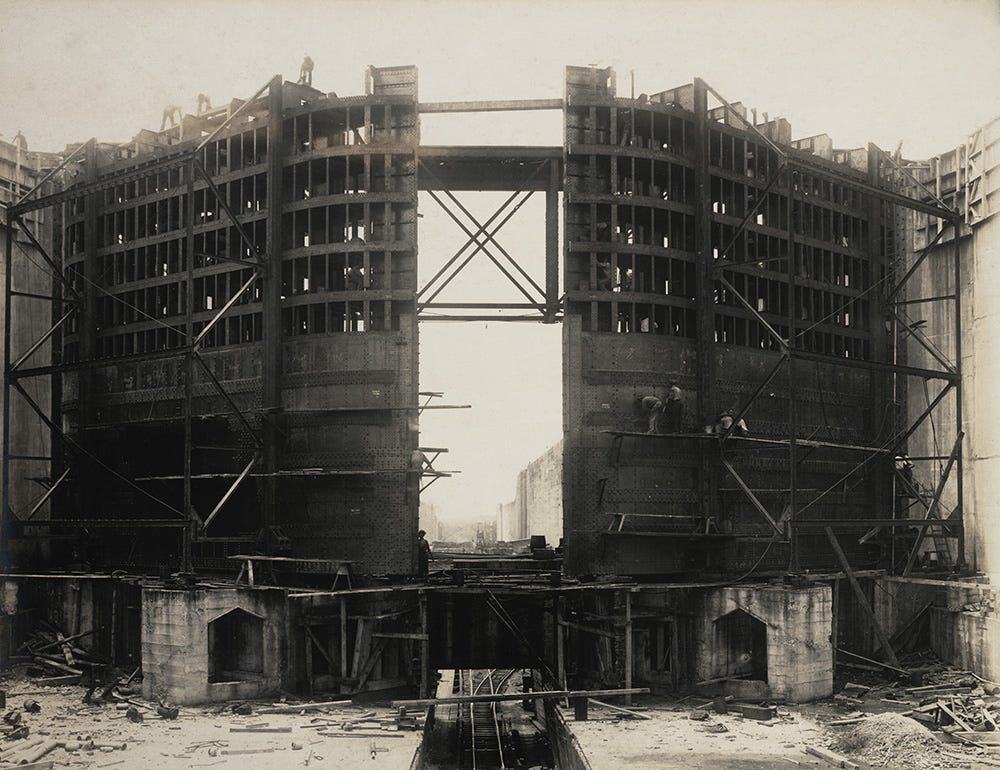
A set of lock gates at Gatun. Credit: https://panama.lindahall.org/locks/
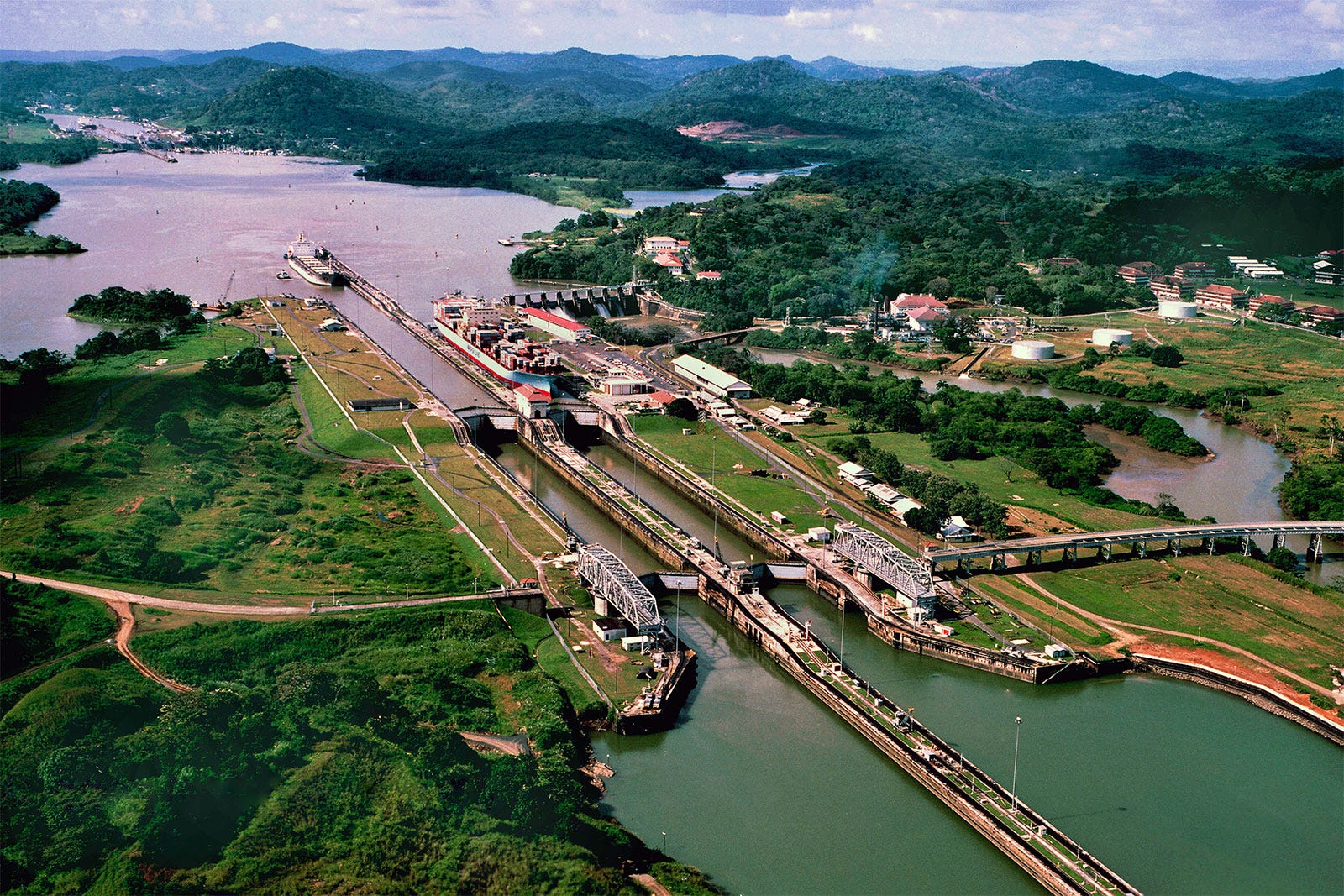
At Gatún, a dam was built to control the Chagres River and create a lake that would submerge much of the Panama Canal route. The lake provided water for a system of locks (devices to raise and lower ships) to lift the boats from the sea to the lake for the trip through the canal and for two more sets of locks at Pedro Miguel and Miraflores, which raised and lowered ships on the Pacific side of the Isthmus. When the lake was filled, it submerged 164 square miles of jungle.
The construction of the locks was a colossal undertaking. Each lock was 110 feet wide and 1000 feet long. To build these locks, workers had to dig four large chambers underground and remove 4 million cubic yards of dirt and rock. The gravity-operated canal system uses these channels to raise or lower ships 85 feet above sea level.
Credit: Encyclopediabritannica.com
On August 15, 1914, the Panama Canal opened to commercial traffic. Due to World War I, the grand opening ceremony was delayed. The canal cost over $350 million to build (equivalent to more than $9.7 billion today) and took ten years to complete. About 25,000 workers died during construction from accidents and tropical diseases.

