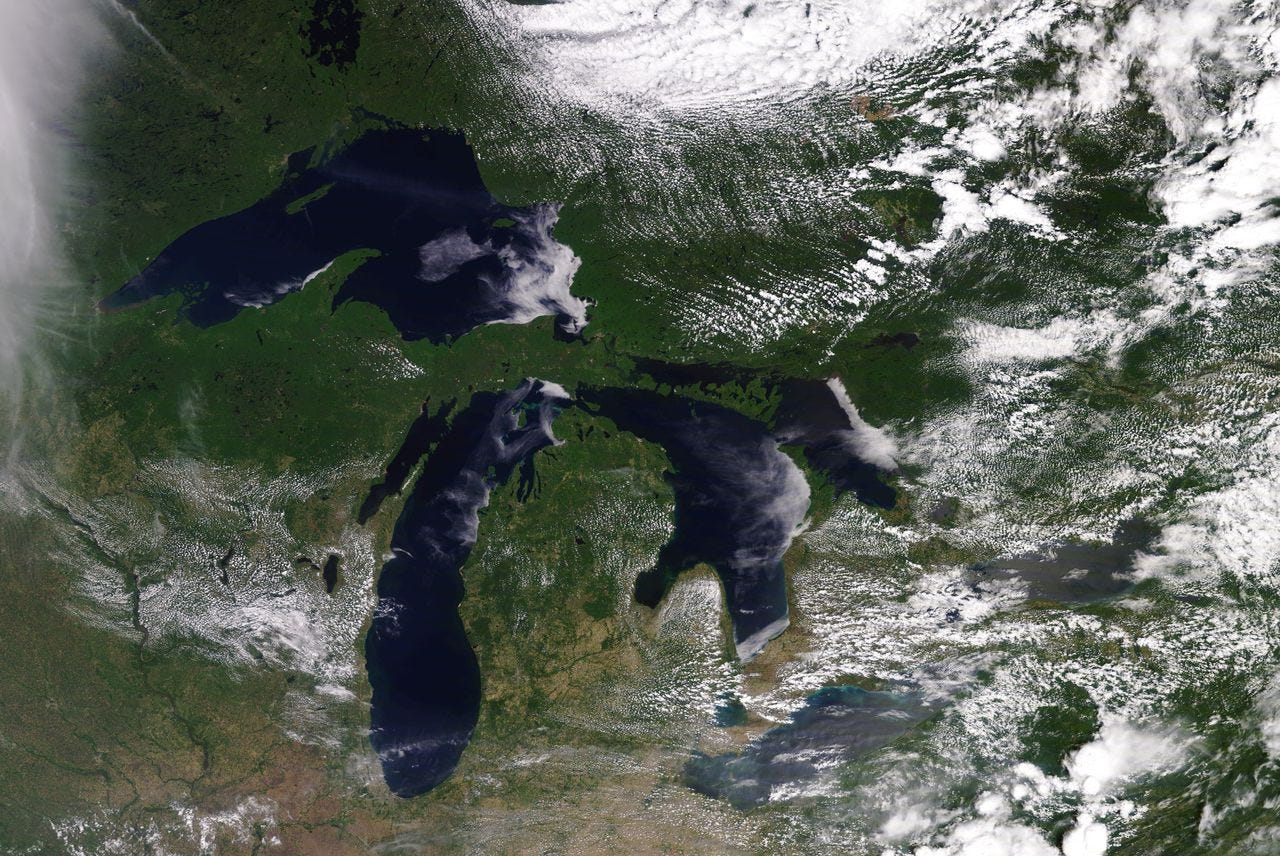
Satellite View of the Great Lakes. Credit: https://www.cleveland.com/
Tides on the Great Lakes
It’s a well-known fact that the Great Lakes are the largest group of freshwater lakes globally, but did you know they also have the smallest tides? This is because they’re not oceans but large bodies of water. Still, some tides occur in these lakes, though they’re almost imperceptible. So what’s going on?
Gravity Still Matters
It comes down to the same thing that creates tides in oceans: gravity. But since the Great Lakes are so far inland, the gravitational pull from the moon and sun is much weaker than on the oceans themselves. While there are still small tides in the lakes, they’re almost unnoticeable; they’re only about 6 inches high and low. So why aren’t the Great Lakes’ tides more noticeable?
It’s all because of the lakes’ size. Unlike ocean water, which is deep and spread out, the Great Lakes are shallow and smaller. And as a result, they don’t respond to the moon or sun in quite the same way as oceans do. Sure, you’ll see some small fluctuations along the shoreline, but if you saw them from space, you’d never know it.
Weather and Seasonal Water Levels
The water levels in the Great Lakes change over time. Long-term changes depend on precipitation and water storage. The annual changes are related to the seasons. In the winter, water levels decrease while they increase during the late spring. These changes can occur at rates as high as four feet per month.
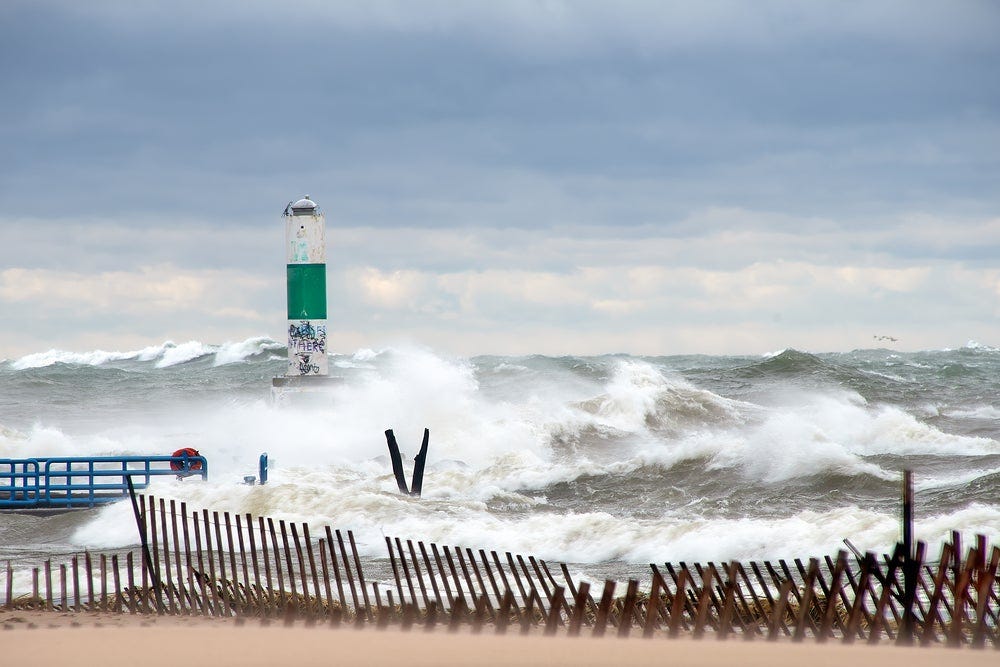
Storm on Lake Michigan. Credit: https://www.popsci.com/ via Jentara/Deposit Photos.
The lakes can also be affected by the weather. If a coastal area is experiencing heavy rain, it can be hard to tell whether the tides or the rain are to blame for its water level.
Whenever there is wind on a lake or ocean surface, it creates a seiche. A seiche is a series of waves oscillating in an enclosed water system, like a bay or lake. Have you ever seen water sloshing back and forth in a bathtub or swimming pool? When strong winds blow over bodies of water, the water, and sometimes even boats, move from one side to the other. When the wind stops blowing, the water can oscillate back and forth for hours or even days.
The Great Lakes — Huron, Ontario, Michigan, Erie, and Superior — contain over 20% of the world’s fresh water supply, enough to cover the 48 contiguous states under about 9.5 feet of water. The rivers connecting the lakes include the St. Marys River, which links Lake Superior with Lake Huron; Niagara River connecting Lake Erie with Lake Ontario; and the Straits of Mackinac, which merges Lake Michigan with Lake Huron (geologically, the two lakes are considered one).
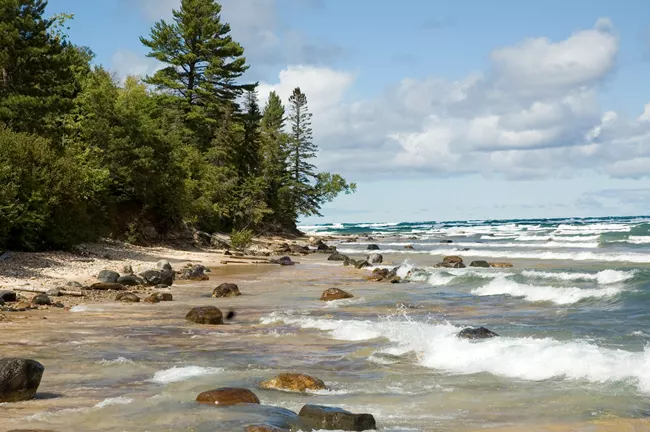
Lake Superior. Credit: https://www.nps.gov/
The lakes range widely in size, depth, and surface area. Superior is the biggest, deepest, and most voluminous of the lakes; Erie is small by volume but has sizeable shallow water areas. Lake Michigan is the only lake in the Great Lakes to lie entirely within one country’s borders: it straddles the United States — Canada border. Large islands dotting its surface include Ontario’s Manitoulin Island and Michigan’s Drummond Island.
If you live along Lake Michigan or any other great lake, chances are good that you will never notice its very subtle tides.

